
What Is ROAS? How to Calculate ROAS and Break-even ROAS
You spent 1,000 on ads and made 3,000 in sales. Is that good? It depends. Many store owners celebrate a “3x ROAS” while actually losing money, because they never worked out the ROAS they need just to break even.
This guide explains ROAS, break-even ROAS, and how to use both to make better advertising decisions.
What is ROAS?
ROAS stands for Return on Ad Spend. It measures how much revenue you earn for every unit of currency spent on advertising.
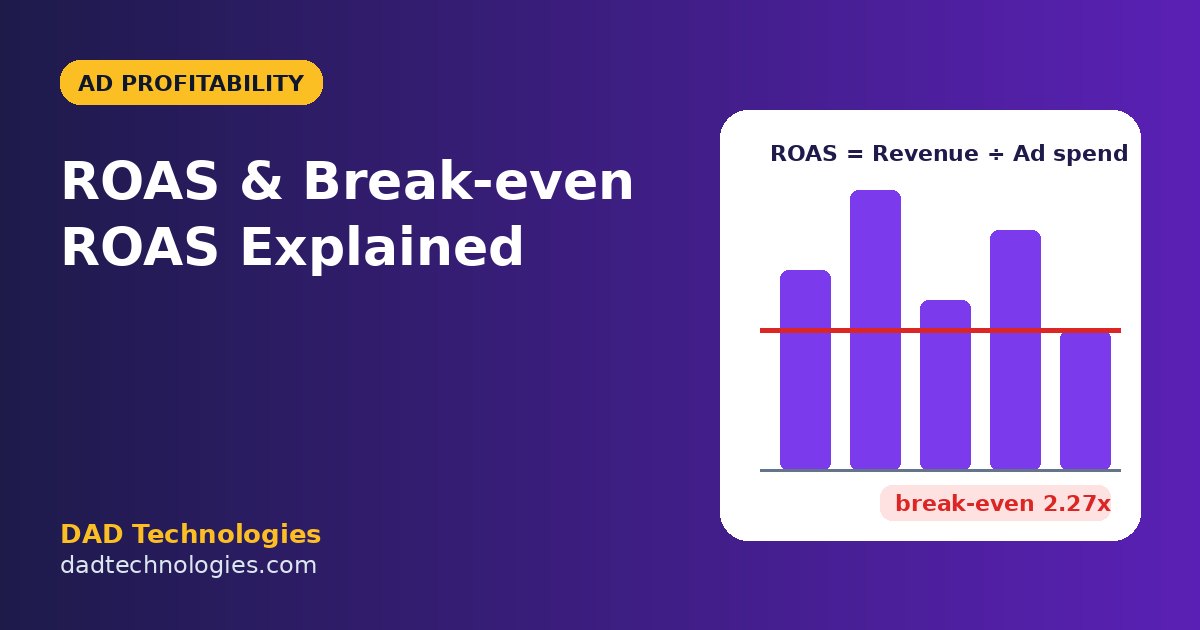
ROAS = Revenue from ads ÷ Ad spend
Example: ads cost 500 and brought in 2,000 of sales.
2,000 ÷ 500 = 4, often written as 4x or 400%.
You can calculate it instantly with our free ROAS Calculator.
Why ROAS alone can mislead you
ROAS uses revenue, not profit. Revenue still has to pay for:
- product cost (or supplier cost for dropshipping)
- shipping and packaging
- payment processing fees
- platform or app fees
- returns and discounts
A 3x ROAS on a product with a 25% margin loses money. The same 3x ROAS on a product with a 60% margin is very profitable. That is why you need break-even ROAS.
What is break-even ROAS?
Break-even ROAS is the ROAS at which your ads cover their own cost and your variable costs, leaving zero profit and zero loss.
Break-even ROAS = 1 ÷ Profit margin (before ad spend)
Where profit margin = (Price − variable costs) ÷ Price.
Example
- Selling price: 50
- Product cost: 20
- Shipping: 6
- Payment fees: 2
- Variable costs total: 28
- Margin before ads: (50 − 28) ÷ 50 = 0.44 (44%)
Break-even ROAS = 1 ÷ 0.44 = 2.27
So any ROAS above 2.27 is profitable on the first sale; anything below it is losing money.
Use our Break-even ROAS Calculator to enter your own price and costs.
Quick reference: margin vs break-even ROAS
| Margin before ads | Break-even ROAS |
|---|---|
| 20% | 5.0 |
| 30% | 3.33 |
| 40% | 2.5 |
| 50% | 2.0 |
| 60% | 1.67 |
| 70% | 1.43 |
The lower your margin, the harder your ads have to work. This is why low-priced, low-margin products are difficult to scale with paid ads.
What is a “good” ROAS?
There is no universal number. A good ROAS is one that is comfortably above your break-even ROAS and leaves room for overheads and profit. Many advertisers set a target ROAS around 20–50% above break-even.
Also consider:
- Customer lifetime value: If customers buy again, a first-order ROAS slightly below break-even can still be profitable over time.
- Testing phase: New campaigns often start below target while the platform learns.
- Attribution: Platform-reported ROAS may differ from your store’s real sales. Compare with your store data.
How to improve ROAS
- Raise average order value with bundles, upsells and free-shipping thresholds.
- Improve conversion rate – faster pages, better product images, clear reviews and trust badges. Check yours with the Conversion Rate Calculator.
- Refresh creatives – ad fatigue raises costs. Test new hooks and formats regularly.
- Tighten targeting and exclude recent buyers from acquisition campaigns.
- Increase margin by negotiating supplier prices or adjusting your pricing. See the Profit Margin Calculator.
- Track properly – use UTM parameters and make sure your pixel and conversion events fire correctly.
ROAS vs ROI
ROAS looks only at ad spend versus revenue. ROI (return on investment) compares total profit with total investment, including product, staff and tools. ROAS is best for judging ads; ROI is best for judging the business as a whole.
Frequently asked questions
Is a ROAS of 2 good?
Only if your margin is above 50%. Check your break-even ROAS first.
How do I calculate ROAS as a percentage?
Multiply ROAS by 100. A ROAS of 3.5 is 350%.
Should I include shipping in break-even ROAS?
Yes, if you pay it. Include every variable cost per order.
What’s the difference between ROAS and break-even ROAS?
ROAS is your actual result. Break-even ROAS is the minimum result you need to avoid a loss.
Want help running profitable Meta, Google or TikTok campaigns? Contact DAD Technologies for digital marketing support.